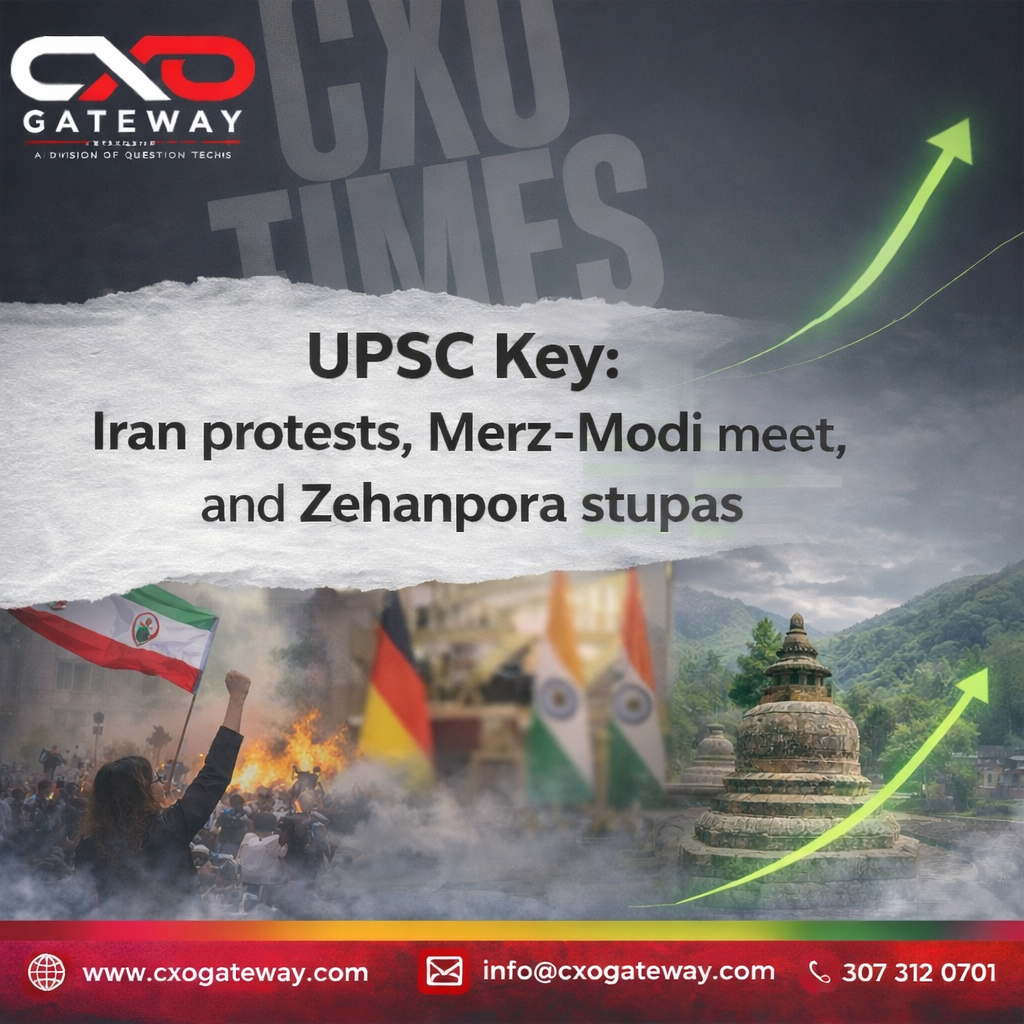
In today’s UPSC news roundup, there are three highlights: the ongoing protests in Iran, the recent meeting between German Chancellor Friedrich Merz and Prime Minister Narendra Modi, and the archaeological discovery of the Zehanpora stupas. Candidates should focus on current events, international relations, and their roots in India?
The Social Struggle and Political Unrest in Iran Lead to Protests?
Mahsa Amini, who was arrested for breaking Iran’s rigorous dress code and died in September 2022 at the hands of authorities, has triggered mass protests across the country. The protests, which began with a push for women’s rights, have now become centered on demanding political freedoms and economic justice, as well as ending authoritarian rule.
Political repression, economic instability and social discrimination all contribute to these protests.’ Despite the government’s strict bureaucracy, opposition is often met with severe criticism. Government control of media, unemployment rates, and rising inflation have only intensified public frustration.
Women’s role in Iranian society is also being questioned, particularly with the morality police’ mandated dress code. Why is this? Mahsa Amini‘ death triggered outrage throughout the nation and calls for freedom of speech, gender equality, and accountability from those in power. The deaths were followed by widespread anger over her killing.
The protests have been suppressed by the Iranian government through arrest, Internet restrictions and security measures. Human rights organizations have condemned these actions, citing a violation of fundamental freedoms. Despite these initiatives, protests persist, demonstrating profound discontent with government and social structures. “.
UPSC aspirants must have a thorough understanding of the functioning of governance, human rights, and international relations in the Middle East.
Merz-Modi Meeting: Strengthening Indo-German Relations.
New Delhi hosted a crucial meeting of Germany’s Chancellor Friedrich and Prime Minister Narendra Modi for diplomatic efforts. In their discussion of the significance of Indo-German relations for trade, investment, cooperation on energy security, and technological collaboration.
Main topics of the Meeting.
Economic Partnership:
The two leaders emphasized trade and investment, with a particular emphasis on manufacturing, renewable energy, and technology. This meeting is designed to strengthen the relationship between India and Germany, who are both important trading partners of India.
Energy Security and Climate Change:
The renewable energy prospects in Germany are complementary to India’s ambitious energy goals. Together, they talked about initiatives aimed at joint solar energy and green infrastructure initiatives.
Technological Collaboration:
In order to create a knowledge economy and encourage research collaboration, they examined possibilities in artificial intelligence technology, digital innovation, and cybersecurity.
Global Governance and Security:
In response to concerns about geopolitical tensions and cybersecurity risks, the leaders emphasized the importance of multilateral collaboration.
Merz-Modi discussions also demonstrate India’s increasing significance in global strategic alliances. The focus was on recognizing the significance of understanding bilateral diplomacy, trade negotiations and sustainable development objectives.
The Zehanpora Stupas Museum is dedicated to the preservation of archaeological and historical sites.
The Zehanpora stupas’ discovery has been a significant development in terms of both archaeological and cultural value. The Mauryan and post-Maurya buildings in northern India are a testament to the growth of Buddhism in various regions.
Stupas, which are Buddhist monuments and places of prayer and pilgrimage, are frequently visited. The Zehanpora stuparies offer a glimpse into both early Buddhist architecture and ancient religious practices, as well as trade networks.
Implications for Heritage Conservation.
It’s important to preserve archaeological sites, especially the Zehanpora stupa. Archaeological Survey of India (ASI) is taking significant steps in the field of excavation, documentation and public education. These results bolster India’s might and attract intellectuals from around the world and tourists interested in Indian history or religion.”.
The national, international and ethnic angle.
Even though the Iran protests, Merz-Modi meeting and Zehanpora stupat are isolated in their own world, they work together to prepare for UPSC. Why?
Governance and Human Rights:
The Iranian protests raise doubts about the impact of authoritarian regimes and economic and social policies on citizen unrest. Why?
International Relations:
The Merz-Modi meeting is in line with the concerns of UPSC about India’s foreign policy and stresses the importance of bilateral diplomacy and economic cooperation. Why
Cultural and Historical Awareness:
The preservation of heritage and the acknowledgement of ancient cultures are central to their Zehanpora stupans.
A combination of political, economic and cultural factors is important for Mains answer writing and interview.
Iran Protests:
Affects the topic of international relations, civil rights and feminism.
Merz-Modi Meeting:
Enhances the global reach of India through trade, energy supply and technological alliances.
Zehanpora Stupas:
Through archaeological research and cultural preservation, Indian soft power has been strengthened.
Integrated Analysis:
Integrating external factors with domestic issues and cultural roots enhances the quality of answers and analytical thinking in UPSC exams.
Conclusion.
Major changes have been made to the preparation for UPSC in January 2026… Human rights and civil disobedience are the focus of the Iran protests. The Merz-Modi meeting demonstrates India’s eagerness to engage with foreign partners in trade and technology. In this period, the Zehanpora stupares showcase India’s accumulated archaeological heritage.
Connections to current affairs, world policy and international relations or cultural studies are required for these events. UPSC examinations demand expertise in governance, diplomacy, and history, which are closely intertwined through the observation of these changes.