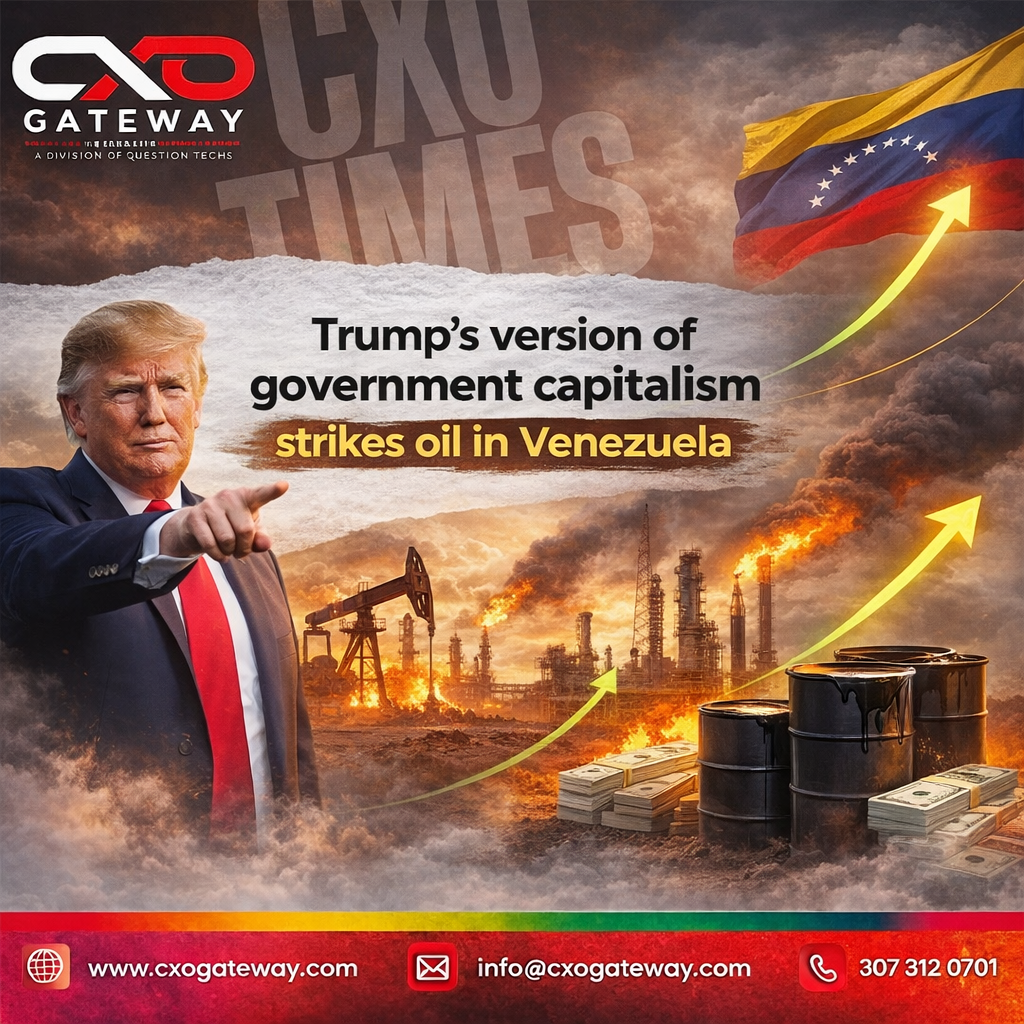
In the first days of 2026, in a surprising geopolitical move, U.S. President Donald Trump has turned Venezuela, a country rich in oil, into a flagship of a daring and somewhat scandalous plan. A plan initially based on political change and economic sanctions against Nicols Maduros regime has now resulted in the U.S. military taking over Venezuelan oil facilities and drawing up production and revenue sharing plans for years. Proponents see this as a ‘government capitalism’ model, mixing government power with market mechanisms, whereas opponents accuse the U.S. of overstepping, imperialism, and possibly breaking international laws.
This rapidly changing affair deeply affects U.S., Venezuela relations, the worldwide energy markets, the political calm in Latin America, and the economic future of Venezuela.
A Dramatic Shift in Venezuela: From Sanctions to Direct Oversight
In January 2026, a military operation involving U.S. troops resulted in the ousting and the subsequent detention of Venezuelan President Nicols Maduro and his wife. According to the U.S., this move was a part of the fight against supposed corruption and drug trafficking, which caused a major power change in Caracas. After that, interim head Delcy Rodrguez whose appointment is extremely disputable declared her rule just as the U.S. was rapidly gaining control of Venezuelan oil fields.
Trump and his team of advisors have since adopted a policy that tightly connects U.S. economic policy with energy dominance. The biggest factor in this policy is the claim that Venezuela will sell 30 to 50 million barrels of oil to U.S. markets, with the income being strictly controlled by U.S. authorities. Trump has therefore presented this move as a win, win situation for both the Venezuelan people and U.S. energy security. However, scholars of law argue that such control has not been granted a firm basis in international law.
Government Capitalism Meets Energy Policy
The Trump administrations Venezuela policy stands out as a departure from traditional free, market norms. Instead of simply sanctioning and privatizing the energy sector, the U.S. under Trump was seeking to play a major role in production and distribution of Venezuelan oil, which is a blend of state power and business goals. This mix of state involvement and market orientation is what some scholars would call government capitalism, a situation where the government directly controls key areas of the economy.
U.S. Energy Secretary Chris Wright has publicly declared a strategy which entails not just ramping up Venezuelan oil output but also ensuring that the U.S. has indefinite control over the sales of the oil. According to senior officials, the idea is that Washington will be able to sell crude oil from Venezuela in the local as well as the foreign market while the money will be deposited into accounts controlled by the U.S. The officials claim that such a scheme would be a win, win for both the Venezuelans and the Americans.
Economic Strategies and Market Aspirations
Venezuela boasts the most massive proven oil reserves in the world; however, its output has been on a downward spiral for the last decade due to various factors such as sanctions, corruption, and lack of investment. Through the Trump administration’s plan, U.S. firms could be either asked or given incentives to pour in billions of dollars to modernize the Venezuelan facilities. Trump has suggested that the big oil firms in America could be repaid or rewarded from the earnings once the production is back on track.
This approach seems to be connected to the idea of energy prices as well.
Trump stated that increasing Venezuelan output on a large scale might lower US gasoline prices in practice. However, specialists point out that major changes would require heavy investments and several years of the development of facilities. Venezuelan oil is a heavy type and must be processed in a specialized way, which means that fast growth is a long, term project and not a quick fix.
Regional and Global Market Impact
The control of Venezuela’s oil resources is just one aspect of a broader strategy. The U.S. has also confiscated several oil tankers that were suspected of breaking the sanctions, with the goal to limit the number of alternative buyers and routes. This move is to weaken the clout of geopolitical rivals such as Russia, China, Iran, and Cuba, all of which have kept relations with Caracas.
Besides the geopolitical angle, this plan adds to the complexity of global energy markets. At present, Venezuela’s share in global oil production is less than 1%, however, the country’s huge reserves could have a notable effect on prices and supply if developed. Still, investors are wary because of Venezuela’s legacy of nationalizations and political instability.
Economic Chaos at Home and U.S. Leverage Abroad The Venezuelan economy is in a deep crisis as the bolivar continues to lose value and inflation is expected to surpass 600%. People are stocking up on foreign currency as prices are going through the roof and a good number of shops are closing, thus, the country is approaching an economic breakdown. At the same time, the interim government is in talks with Washington, showing some skepticism of U.S. moves, which points to the fragile situation between cooperation and national sovereignty.
Controlling Venezuelan oil sales is seen by the U.S. as a strategic weapon. By meddling in the energy and money channels, Washington wants to influence the political and economic conditions in Caracas and all-over Latin America. With this influence, energy security for U.S. refineries could be tightened, supplies from adversaries could be cut, and American geopolitical objectives could be supported.
Criticism and Legal Challenges Even though the Trump administration tried to present its policy as a win for stability and prosperity, critics have made some very important points:
Legal scholars have pointed out that taking control by force over the natural resources of another country without internationally recognized consent would be a violation of international law. The focus of the debate is mainly on the issues of sovereignty and U.N. regulations.
Economists warn against overestimating the supposed ‘value’ of Venezuelan oil. They remind us that the current production level is very low and that those who look optimistically to the future are basing their expectations on decades of investment.
Some people describe this policy as resource imperialism, where energy and strategic interests take precedence over democracy and human rights.
Regional leaders and Latin American civil society are accusing the U.S. of engaging in hemispheric interventionism of the past; thus they draw a parallel to the strategies used during the Cold War.
Political Dynamics and Partisan Response
As far as the U.S. is concerned, the reaction has tended to be very polarized. There are some members of the Congress and some commentators who have praised the measure as the U.S. showing its strength and leadership in the energy sector globally. On the other hand, there are also some Democrats and others who are against it because they see it as the President exceeding his powers without seeking the approval of the Congress and that it might result in a war with another country.
It is interesting to note that the participation of senior politicians in Congress like Senator Marco Rubio who has been involved in the discussion of future including proposals of huge expenditures and strategies for selling, shows an interest across the political spectrum in the economic dimensions of the U.S. Venezuela policy.
Looking Ahead: Uncertain Horizons Will Venezuela be able to keep its oil industry functioning normally under the supervision of the U.S.?
There are countless variables to consider legal wrangling, market trends, local Venezuelan politics, and changes in global energy demand that are all around to affect what comes out of the situation probably next year or even in the longer term.
Some of the major challenges for the energy sector in Venezuela are:
Replacing the equipment and facilities will not only be very expensive, but it will also take a very long time. The lack of a qualified workforce and the departure of experts from industry make it even harder to plan for future growth. Issues concerning the political legitimacy of the ruling authorities and who will be in power in the long run are still very divisive.
However, the Trump administration focusing on direct control over Venezuelan oil is one of the most aggressive utilizations of government powers in the worldwide energy sector in recent decades which also points to a move toward the state, led strategic capitalism model as energy security stays a major national priority.
Conclusion: Oil, Power, and the New American Strategy President Trump’s method of handling Venezuela and its oil is a result of the intricate relationship between military power, economic desire, and political tactic. It is unclear at this point whether this policy will economically benefit the United States or if it will come with higher diplomatic, legal, and geopolitical costs. What is clear is that energy policy, which used to be mostly commercial, has become a major tool of American statecraft, under the government, oriented capitalism label.
As things develop, the world will be watching with interest whether this move helps the U.S. maintain its influence over the long term or if it will simply add to the tensions in a historically unstable area.