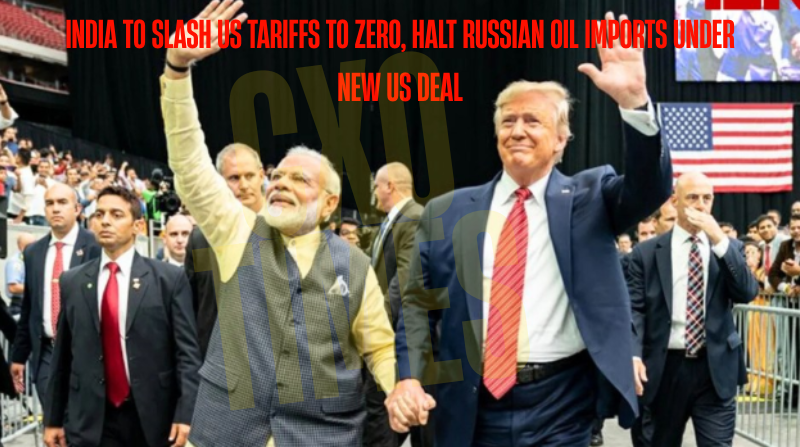
New deal signed by United States and India over trade with India is exciting for international commerce and politics. A significant reduction in tariffs on Indian goods is achieved through India’s decision to stop importing Russian oil. On February 2, 2026, the announcement of this agreement marked “the conclusion of a long-term economic relationship between these two nations through ongoing discussions and tariff disputes.”.
The text provides a detailed account of the deal, including its rationale, and how it has affected international politics.
Significant Tariff Cuts
This deal is primarily concerned with the reduction of US tariffs on Indian imports. US President Donald Trump said the tariff on Indian goods would be reduced to 18 per cent from a projected 50% tariff set last year.
India’s manufacturing products and textiles, which are the primary components of its export market, will be subject to this new tariff. India’s ability to compete with other major export nations like Vietnam and Bangladesh, which were previously subjected to tariffs of approximately 19%, is enhanced by the change.
The US administration sees the reduction of tariffs as an effort to ease trade tensions and enhance economic ties between China and India. Prior to this, the high tariffs had caused trade disruptions and market uncertainty.
The Russian Oil Factor and the Negotiation Process
The negotiation was dominated by a controversial debate regarding India’s continued use of Russian crude oil. In the past, India has been a significant consumer of Russian oil at exorbitant prices, which the US believed would indirectly support Russia’s economy while it engaged in conflicts with Ukraine.
The US imposed a 25% punitive tariff on Indian imports as repercussions from oil purchases, leading to tariffs of up to 50% on various Indian products.
According to the new agreement, the reduction in tariffs will be contingent on India halting imports from Russia. The US believes that this will result in a decrease in
revenues and potentially weaken Moscow’s economic strength during the ongoing conflict, according to officials.
American energy products are expected to become more widely available in India, with the possibility of using Venezuelan crude oil within broader energy plans.
Action Taken for American and Improved Market Access
The deal includes crucial commitments to strengthening economic ties, as well as tariff reductions and changes in energy sources. The US has committed to buying billions of dollars in US goods, including energy, technology and agricultural commodities, President Trump said. The total amount, estimated at close to $500 billion, has not yet been verified by India.
Furthermore, Trump declared that India will attempt to eliminate all tariffs on Indian goods as it works through the specifics.
In response to the news, Prime Minister Narendra Modi declared that the tariff cut will result in Indian products being sold at a much lower cost than American products.
Background: Months of Trade Tensions
This pact significantly strengthens bilateral relations between the US and India, which were previously fragile. Throughout 2025, both nations engaged in prolonged discussions regarding market access, trade imbalances, and energy policies.
US tariffs on goods were criticized by Indian officials as “unfair” and counterproductive.
Despite these tensions, both parties continued to communicate, with the goal of preventing a complete trade breakdown that could harm global trade.
Methods for the Indo-Pacific and Global Markets
1. The obliteration of Russian oil by India signifies a significant shift in global energy dynamics. The third-largest crude oil importer, India, historically relied on Russia. The movement towards worldwide energy markets has the potential to grant significant power to individuals from various backgrounds.
While it may help coordinate with Western sanctions against Russia, this move requires changes in India’s refining and supply infrastructure. Why?
2. By cutting tariffs, US-India trade is expected to be revitalized, making it one of the world’s top economic partnerships. Lowering trade barriers will be advantageous for both countries, particularly among manufacturers and exporters.
Textiles and automotive parts are among the items that Indian exporters can benefit from the tariff reduction in the US. With India’s commitment to reducing trade barriers, there is more potential for US companies in agriculture, technology and energy.
Geopolitical Effects
However, the deal has implications beyond economics. Increasingly, the relationship between two major democracies has become stronger as global alliances continue to form.
US Perspective
From America’s standpoint, the agreement supports several significant goals:
- Reducing Russian oil revenue,
- Developing relationships with an essential Asian partner,
- Addressing trade imbalances,
- Limiting Russia’s influence in the global arena….
India’s Position
The agreement is a tough line for India to follow. Though Russian oil decommissioning could sever long-term relations with Moscow, it also strengthens India’s economic and strategic links with the US, which is becoming increasingly important to its foreign policy.
However, India stresses that its decisions are based on national interests such as energy security for the welfare of its large population.
Looking Ahead: Implementation and Challenges
The tariff reductions and commitments are effective immediately, as stated by both leaders, but certain aspects require official approval and implementation.
Speculation suggests that in-depth deliberations are necessary on certain matters, including the acquisition of US goods and India’s tariff reductions.
Moreover, specialists emphasize that the process of curbing energy imports from Russia won’t be an easy one as India’s refining industry is complicated and has contracts in place. Why is this so?
Conclusion
The trade agreement between the US and India is a crucial development, as it includes an 18% tariff cut in exchange for India discontinuing oil purchases from Russia. New trade and cooperation opportunities reflect changing geopolitical interests. International markets and policymakers will closely monitor the implementation of this complex agreement as both countries await future developments.