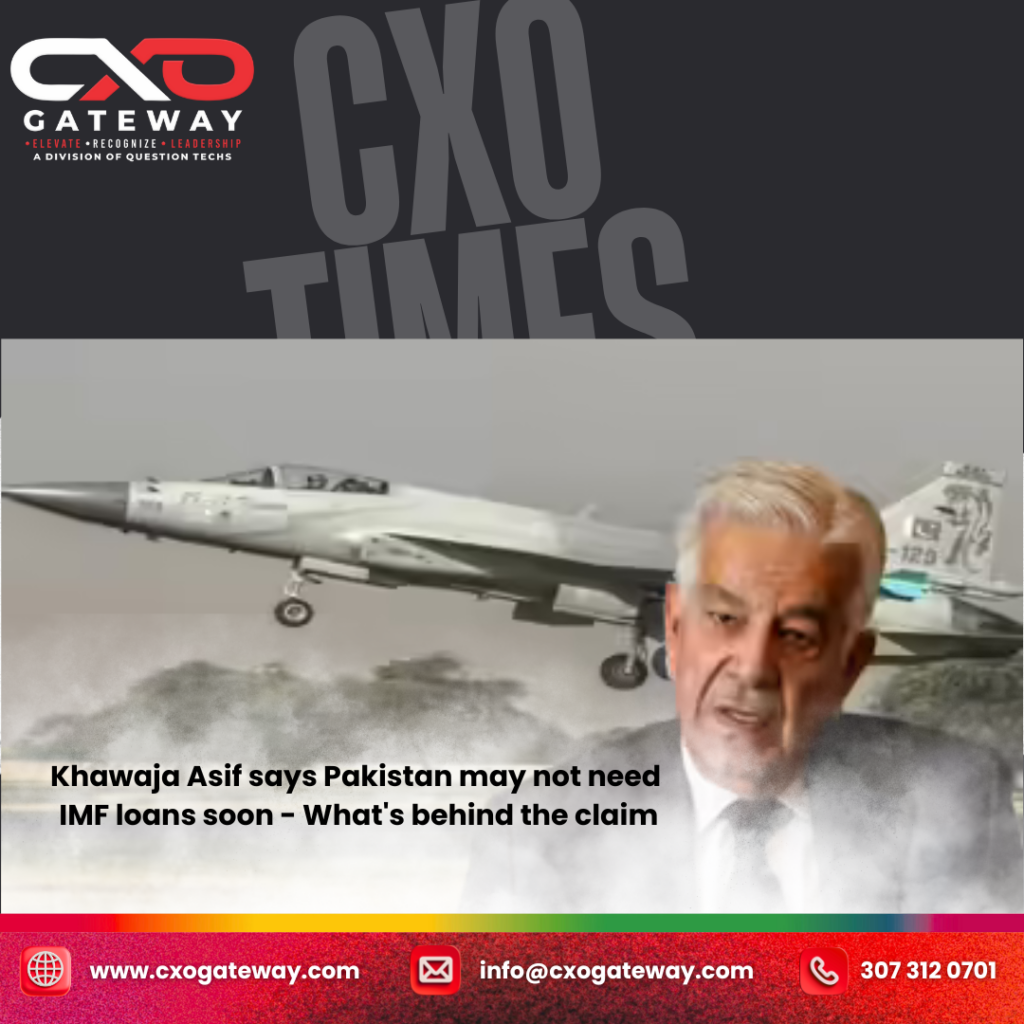
Pakistan’s usually complicated relationship with the International Monetary Fund (IMF) has been in the news again. Defence Minister Khawaja Asif has recently hinted that the country may not require any further loans from the IMF for quite some time going forward. This unexpected statement by a high, ranking government official has generated a lot of discussion among economists, investors, and ordinary folk.
For a country that keeps going back to the IMF for economic stabilization, this poses a very big question: Has Pakistan really started to recover, or is it just a case of political optimism ahead of economic realities?
To better understand Khawaja Asif’s words, one needs to consider Pakistan’s overall economic situation, the recent reforms, the trend in the external financing, and the persistent challenges that determine the country’s financial tomorrow.
The remark that brought focus on details
Khawaja Asif’s statements suggested that the state of the Pakistani economy might be getting better to the extent that the government would no longer be so dependent on the IMF. He did not completely dismiss the possibility of getting more help later but the way he spoke implied that the administration felt more and more confident that it could solve the financial problems through other avenues.
These comments matter a lot since, generally, the IMF programs have been viewed as a last resort, which usually results in tough austerity measures, subsidy cuts, tax hikes, and currency adjustments. For the ordinary folks in Pakistan, IMF programs usually signify those times when inflation goes up and so do the living costs.
Thus, Asifs statement is a figurative combination of the economic and political spheres.
Pakistan’s Long History With the IMF
Over the years, Pakistan has had multiple interactions with the IMF. Starting from the late 1950s, the country has sought more than 20 IMF programs, a phenomenon mirroring the recurrent crisis of the balance, of, payments, fiscal deficits, and sluggish export growth.
IMF loans have generally been employed to:
help stabilize foreign exchange reserves, enable a country not to default on its debts, bring back investor confidence, raise funds from other lenders through additional financing. The fact that IMF programs only tackle the symptoms and not the root causes is a regular argument by those critical of the IMF, especially considering how Pakistan is not able to implement long, term structural reforms after immediate pressures relax.
In this context, even a throwaway line that Pakistan might do without IMF support for a while is quite a remarkable indication of a change in the narrative.
What’s driving the Government’s Confidence?
A handful of points would seem to cover some of Khawaja Asifs trust, however they are still debatable.
Pakistan has lined up some money from its friendly nations to help it meet its financial needs. For instance, depositing rollovers and bilateral assistance are some forms of aid the country has recently received. These inflows are significantly helpful to boost the foreign exchange reserve, thus, giving time to the government not to rely immediately on the IMF funding.
On the one hand, these types of deals are great for the government, on the other hand, they usually require the government to follow certain political guidelines which may not be always be in line with the country’s policies.
It’s been said that Pakistan’s foreign exchange reserves are still unsafe by international standards However, they have improved when compared to the previous crises and thus the fear of a balance, of, payments crisis is somewhat reduced.
Greater stability in the currency environment also decreases the immediate requirement for IMF intervention, however, it does not fix the fundamental weaknesses.
The administration has launched a number of fiscal and monetary initiatives which are directed at deficit reduction and inflation control.
These are rationalizing subsidies Bringing in tax measures that increase revenues Monetary tightening to reduce demand Government representatives are of the view that these actions indicate Pakistan can make the necessary changes itself without dependence on an IMF program.
Khawaja Asif’s remarks warrant interpretation from a political angle.
IMF programs haven’t won popular support locally; they are frequently viewed as a blow to our national pride. Hence, by announcing that they won’t be dependent on IMF aid, the government intends to:
Display financial literacy Give a comfort to voters Increase their leverage while negotiating Thus, the government by suggesting that Pakistan might not be in dire need of IMF loans, could be indirectly trying to obtain a stronger position in negotiation for later loan agreements or simply trying to soothe market sentiments before a significant policy decision.
Economists Advise Prudence Despite the listening of the political authorities; a lot of economists are still pleading for a more cautious approach.
The economic shortcomings that have led Pakistan to request IMF bailouts in the past still exist and include the following:
A narrow tax base Low export competitiveness Heavy reliance on imports High public debt Energy sector inefficiencies Unless these basic concerns are resolved, Pakistan’s freedom from IMF support may only be a temporary solution rather than a genuine change.
Can Pakistan Really Skip the IMF?
Here are a few significant areas where Pakistan must get real changes if it wants to avoid IMF loans entirely:
Export Growth
Our exports are still not enough to cover the cost of imports and external debt. If we do not increase value, and exports added significantly, we are going to see the foreign exchange pressure again.
Tax Reforms
Pakistan’s tax, to, GDP ratio is very low. Politically a tough area will be widening the tax net especially among the wealthy classes, but it is necessary for the economy.
Energy Sector Reform
Electricity sector is still a huge burden on public finances. Resolving circular debt and power loss is a must for the economy to be stable in the long run.
Debt Management
Pakistan’s external debt repayment installments are very large. It will be very difficult to manage these without the support of the IMF.
Alternative Financing: A Double, Edged Sword
Pakistan may get some temporary relief by going for bilateral loans or loans from friendly countries instead of the IMF, but it will be facing some dilemmas as well.
Unlike the IMF, which imposes transparency and reform targets on the programs, bilateral financing is opaque and may be contaminated politically. Over, relying on such type of assistance may result in policy, making capacity limited.
Conclusion: Optimism with a Side of Caution
It appears that Khawaja Asif’s statement of Pakistan not requiring IMF loans soon is indicative of the unchanged phase, a period of relative stability and political confidence. It reveals the desire of Pakistan to liberate itself from the economic dependency pattern that has been its fate for the last few years.
However, it is up to the government’s capability of carrying out effective, deep, rooted, and lasting structural reforms to decide which way this situation will lie. If the government fails to do so, once the external environment turns hostile, the need for IMF assistance will be there again.
Now, the statement offers a ray of hope but at the same time, it puts forward a leaning towards caution. The economic destiny of Pakistan will not only be determined by the words but also by the hardest decisions that are to be made.