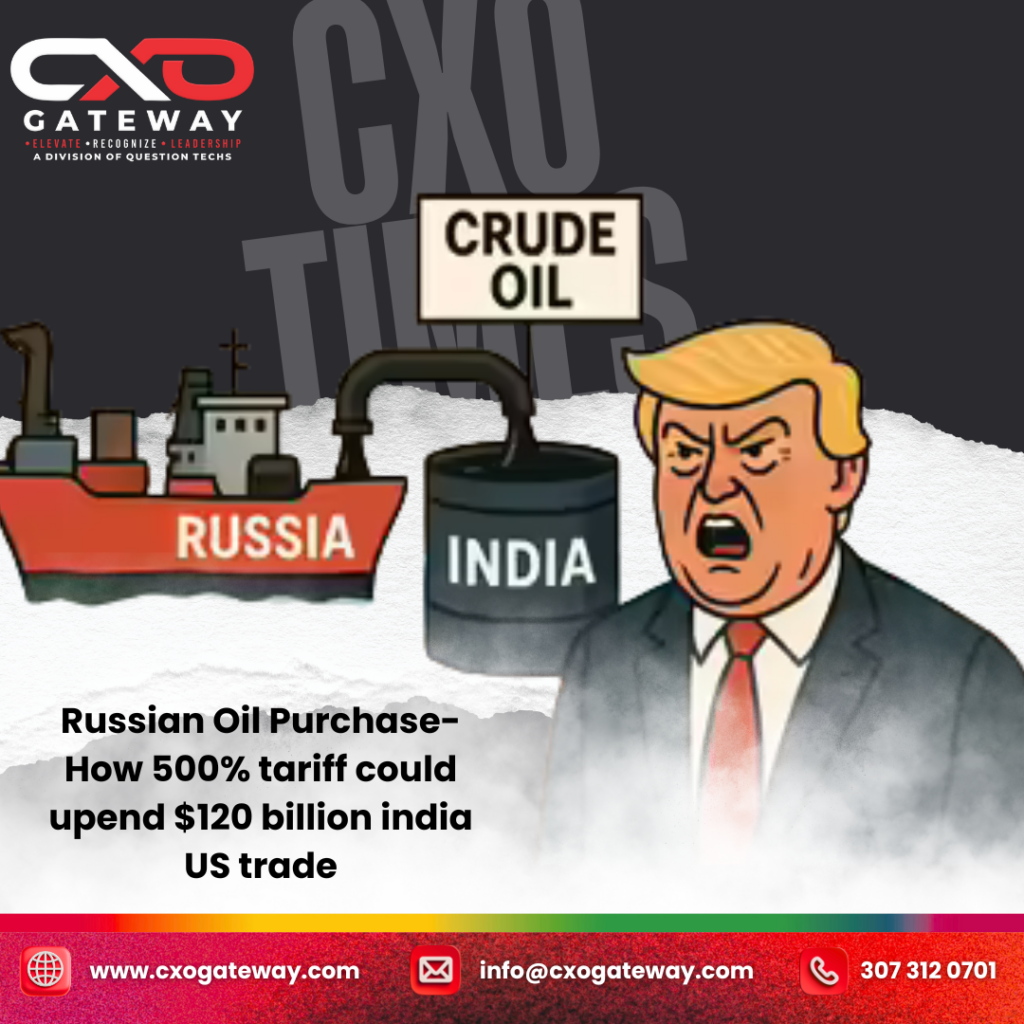
Recent changes in trade relationships between the US and India have gained significant attention. India’s ongoing import of Russian crude oil has become a point of conflict between the world’s largest democracy and its key ally. The US may respond with tariffs that could reach 500% on Indian exports. If this extreme measure is put in place, it would not only change trade figures but also impact on global supply chains, energy markets, and geopolitical relationships.
Let’s examine the situation, its importance, and the broader effects on the roughly $120 billion trade relationship between India and the United States.
Why Is the US Considering a 500% Tariff?
The trade tensions arise from India’s large import of Russian crude oil. After Russia invaded Ukraine in 2022 and encountered Western sanctions, Moscow began selling oil at much lower prices to countries willing to buy. India, known for its refining abilities, took this opportunity, sourcing about 35-40% of its crude oil from Russia at different times, a significant rise from very low levels before the conflict.
The United States, under President Donald Trump, sees these ongoing Russian oil purchases as indirectly supporting Moscow’s military actions. In response, Washington has started penalizing trading partners that continue these purchases. In 2025, the US increased tariffs on Indian imports from the existing rate to 50%, clearly stating India’s purchase of Russian oil as a key reason.
US lawmakers are now pushing for a bipartisan bill—the Sanctioning Russia Act of 2025—that could allow the president to raise tariffs on products from countries knowingly buying Russian oil and its byproducts to at least 500% of their value.
What Would a 500% Tariff Mean for India-US Trade?
The trade relationship between India and the United States is worth about $120 billion annually, covering various sectors like pharmaceuticals, textiles, technology, and engineering goods. A 500% tariff would essentially block Indian exporters from accessing the US market for affected goods since importers would face excessive costs. Even if they tried to pass these costs onto consumers, the resulting higher prices would make Indian products uncompetitive compared to options from other countries.
Here’s what this could result in:
1. Exports Would Plummet
Right now, Indian exports to the US include apparel, textiles, gems and jewelry, chemicals, and engineering products. Many of these sectors cannot easily handle price changes and work on thin profit margins. A 500% tariff would make it nearly impossible to export these goods to the US at competitive prices. Indian manufacturers would quickly lose access to one of their largest and most profitable markets.
Even before a potential rise to 500%, the existing 50% tariffs have already reduced demand in various sectors, causing a drop in order volumes by late 2025, particularly affecting labor-intensive industries.
2. Job Cuts and Economic Slowdown
A major decline in exports to the US would lead to job losses in sectors heavily reliant on American consumers. Regions like Tirupur (textiles), Surat (diamonds), Gurugram, and Noida (leather and chemicals) could face factory closures and a loss of jobs. This shock could ripple through India’s economy, decreasing consumption and lowering growth expectations.
The Federation of Indian Export Organizations (FIEO) has already cautioned that high tariffs reduce competitiveness and may push India to look for alternative markets. However, quickly shifting such large volumes poses a significant challenge.
3. Implications for Services and Non, Tariff Sectors
Bear in mind that the envisaged tariffs pertain primarily to goods. Apart from that, India’s service exports like information technology and business process outsourcing, which are globally competitive, may not be impacted immediately. However, other sectors could be affected if trade relations worsen.
Besides that, foreign direct investment, business confidence, and cross-border collaborations can suffer if political tensions rise. It has been reported that talks have been stalled, and caution is growing diplomatically between New Delhi and Washington.
India’s Strategic Stance
India is in a dilemma. On the one side, the availability of discounted Russian crude has facilitated the decrease in import expenses, inflation control, and enhancement of refining margin profits. On the other side, the country is unwilling to jeopardize its long, term economic ties with the United States.
To demonstrate Indias transparency in its oil sourcing practices, in early January 2026, the government requested its oil refiners to send weekly reports on importing Russian and US oil. This indicates New Delhi’s attempt to juggle geopolitical pressures and economic requirements.
India has always diplomatically emphasized that its energy plan is primarily focused on the country’s needs and energy safety, not on geopolitical considerations. S. Jaishankar, the External Affairs Minister, mentioned that the talks with US officials are still going on, and that Indian deputees are keeping a very close eye on the situation in Washington.
A Turning Point in Global Trade?
Should the US decide to proceed with putting 500% tariffs on countries like India and China for their purchases of Russian oil, the impact would not only be seen in trade figures. To evade the tariffs, exporters might look into other markets and hence global supply chains could be disrupted. Countries could even resort to signing up regional trade agreements, and the energy sectors might be influenced by the fact that geopolitical considerations are taking the lead over pure economic logic.
Furthermore, a move as drastic as this one might lead India down the path of rapidly diversifying its energy import and export markets, which in turn may open avenues for better relations with the EU, the Middle East, Africa, or Southeast Asia.
Final thoughts: an extremely risky move
The suggestion of a 500% tariff on Indian exports arising from its Russian oil, related purchases essentially demonstrate how geopolitics, energy security, and global economics are deeply entangled. It is indeed a critical situation for India, which has to skillfully juggle between securing energy at reasonable prices, safeguarding its national interests, and at the same time, holding on to its business relationship with the United States.
On the other hand, the US, by means of this policy, is seen making a comprehensive attempt to shut off the Russian economy entirely and thereby, dissuade other countries from indirectly bolstering Russia’s wartime economy. Unfortunately, this move may backfire by hampering the very partnerships that are vital.
The developments in the next few months will decide a lot. Besides the passage of the Sanctioning Russia Act, much will depend on India’s diplomatic and economic measures, and the global markets’ reactions. All these factors will determine the future of this major trade.